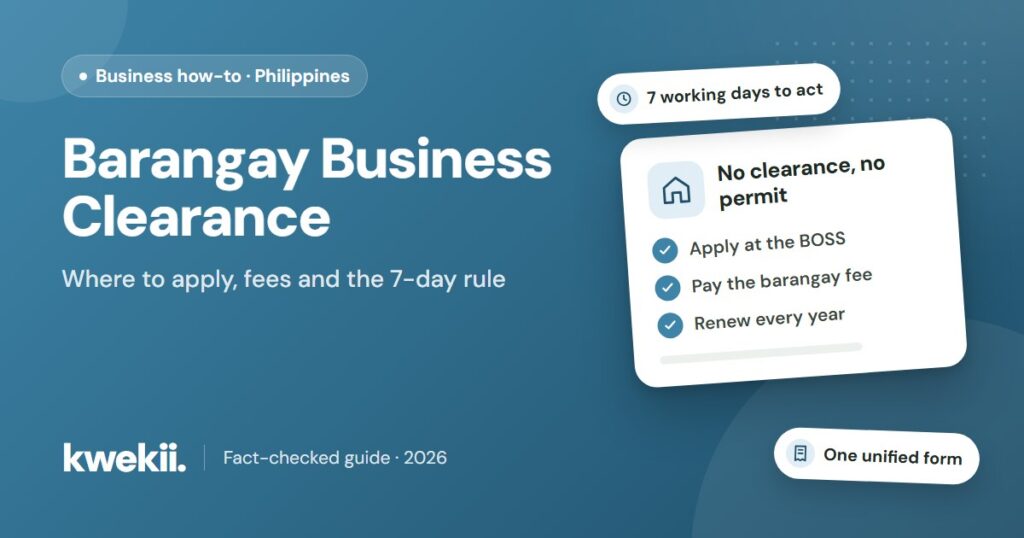
Quick answer: A barangay business clearance is the barangay’s go-signal for a business operating within its area. Under the Local Government Code, your city or municipality can’t issue a business permit without it. Since the Ease of Doing Business Act took effect, you apply for it at the city or municipal hall, usually through the Business One Stop Shop (BOSS), together with your mayor’s permit, and not with a separate trip to the barangay hall. The fee is set by each barangay, and the barangay has seven working days to act on your application.
Key takeaways
- No barangay clearance, no business permit: Section 152(c) of the Local Government Code requires it before the city or municipality can issue a license or permit.
- Apply at the city or municipality, not the barangay. RA 11032 says barangay clearances related to doing business are applied for, issued and collected there, and the barangay gets its share of the fee.
- If the barangay doesn’t act within seven working days, the city or municipality may issue your permit anyway.
- Get it after your DTI business name and before or together with your mayor’s permit; register with the BIR after that.
What a barangay business clearance is
Every business in the Philippines operates inside a barangay, and the Local Government Code gives the barangay a say before the business can get its permit. Section 152(c) of the Code says no city or municipality may issue a license or permit for a business or activity unless the barangay where it is located has issued a clearance. The barangay council (sangguniang barangay) can charge a reasonable fee for it.
In practice, the clearance confirms that your business location is within the barangay and that the barangay has no objection to it. It’s separate from the barangay clearance individuals get for jobs or IDs, so make sure you ask for the one for business.
Where to apply: the city or municipal hall
Before 2018, many owners had to go to the barangay hall first, then carry the clearance to the city hall. The Ease of Doing Business and Efficient Government Service Delivery Act (RA 11032) changed that. Section 11(f) says barangay clearances and permits related to doing business are applied for, issued and collected at the city or municipality, and the barangay’s share of the fee is remitted to it.
The same law requires:
- One form. A single, unified business application form for new permits and renewals, available online and on paper (Sec. 11(a)).
- One place. A Business One Stop Shop (BOSS) in the city or municipality where you can complete the process (Sec. 11(b)).
- Automation. Cities and municipalities must automate their business permitting system or set up an electronic BOSS (Sec. 11(c)).
Some barangays may still ask you to visit for an inspection or to sign a form. Ask your city or municipality’s Business Permits and Licensing Office (BPLO) how it handles barangay clearances.
Step by step
- Register your business name. Sole proprietors register with DTI; corporations and partnerships with SEC; cooperatives with CDA. You’ll need the certificate for your permit application.
- Prepare proof of your business location. Typically a lease contract, or proof of ownership or permission to use the place. Ask the BPLO for its exact list.
- Fill out the unified business application form. Get it at the BOSS or the city or municipality’s website. The barangay clearance is processed with it.
- Pay the fees. The barangay clearance fee is set by the barangay, so it differs from place to place. It’s paid with your other local fees, and the city or municipality sends the barangay its share.
- Wait for the clearance and permit. The barangay must act within seven working days of your application. If it doesn’t, the city or municipality may issue your permit without it.
How long it takes
Two rules apply:
- Barangay clearance: seven working days for the barangay to act (Local Government Code, Sec. 152(c)).
- Government transactions generally: no longer than three working days for simple transactions, seven working days for complex ones, and twenty working days for those involving public health, public safety or highly technical applications (RA 11032, Sec. 9(b)).
Renewal
RA 11032 says business permits are valid for one year. Cities and municipalities can require renewal either within the first month of the year or on the anniversary of the permit’s issuance (Sec. 11(e)). The barangay clearance is renewed with it. Local taxes, fees and charges are generally due within the first twenty days of January, though they can be paid in quarterly installments.
Small stores and the barangay tax
Barangays can also tax small stores and retailers with a fixed place of business. Under Section 152(a) of the Local Government Code, the tax applies to stores whose gross sales or receipts in the previous year were ₱50,000 or less in cities, or ₱30,000 or less in municipalities, at a rate of up to 1% of those sales. Ask your barangay whether this applies to your sari-sari store or stall.
Frequently asked questions
Do I still need to go to the barangay hall for a business clearance?
Usually not. RA 11032 requires barangay clearances related to doing business to be applied for, issued and collected at the city or municipality. Some barangays may still inspect your location, so ask the BPLO how it works in your town.
How much is a barangay business clearance?
It depends on the barangay. The Local Government Code lets each sangguniang barangay set a reasonable fee, so check with your city or municipality’s BPLO or the barangay itself.
What if the barangay doesn’t issue my clearance?
The barangay has seven working days to act on your application. If it doesn’t act within that time, the city or municipality may issue your business permit anyway.
Do home-based and online businesses need a barangay clearance?
If your city or municipality requires a business permit for your activity, a barangay clearance comes with it, because the Local Government Code requires the clearance before any business permit is issued. Ask your BPLO how it treats home-based businesses.
Is a barangay business clearance the same as a barangay clearance for employment?
No. The business clearance is for a business operating in the barangay. The one for individuals is used for jobs, IDs and similar purposes.
Sources
- Republic Act No. 7160, Local Government Code of 1991 (Sec. 152(a) barangay tax on stores; Sec. 152(b) service fees; Sec. 152(c) barangay clearance and seven-day rule; Sec. 165 tax period and installments; Sec. 167 payment within the first twenty days of January)
- Republic Act No. 11032, Ease of Doing Business and Efficient Government Service Delivery Act of 2018 (Sec. 9(b) processing times; Sec. 11(a) unified form; Sec. 11(b) BOSS; Sec. 11(c) automation; Sec. 11(e) one-year permits; Sec. 11(f) barangay clearances at the city or municipality)
This guide is general information, not legal advice. Requirements and fees differ by city, municipality and barangay. Facts were checked against the sources above on November 2, 2026. Researched and drafted with AI assistance, then reviewed and edited by Genmar Dadivo.