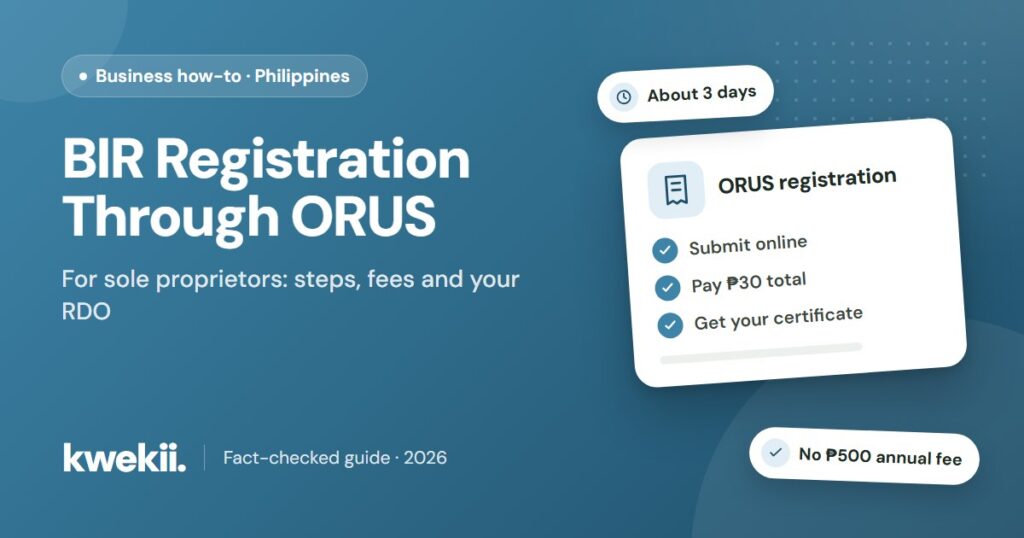
Quick answer: Sole proprietors in the Philippines register with the BIR online through ORUS at orus.bir.gov.ph, on or before the day the business starts. Upload a government ID, a selfie holding that ID, and a sample of your invoice. Once your application is approved, pay ₱30 documentary stamp tax online and download your Certificate of Registration. The old ₱500 annual registration fee was removed in January 2024.
Key takeaways
- Register on or before you start doing business. You can apply online through ORUS or in person at your Revenue District Office (RDO).
- Online registration costs ₱30 in documentary stamp tax, per the BIR Citizen’s Charter 2026.
- Since January 22, 2024, the BIR no longer collects the ₱500 Annual Registration Fee, under the Ease of Paying Taxes Act (RA 11976).
- Have your DTI business name certificate ready if you use a business name.
Who needs to register with the BIR
Self-employed individuals, whether running a business as a single proprietor or practicing a profession, must register with the Bureau of Internal Revenue. This includes small shops, service providers, online sellers and freelancers. The BIR’s Citizen’s Charter says registration must happen on or before the start of business.
For walk-in registration, the Charter explains that the start of business is counted from your first sale, or within 30 calendar days from when your Mayor’s Permit or DTI business name certificate was issued.
Which RDO you belong to
Your Revenue District Office depends on your situation, according to the BIR Citizen’s Charter:
| You are a… | Register with the RDO covering… |
|---|---|
| Single proprietor | The place where your head office (business address) is located |
| Professional | Your residence, or your place of business if you have a physical business address |
| Online seller, vlogger, peddler or other roving business with no physical address | Your place of residence |
What you need to register online (ORUS)
The BIR Citizen’s Charter 2026 lists these requirements for a new individual business registered through ORUS:
- A government-issued ID showing your name, address and birthdate, such as a PhilID/ePhilID, passport or driver’s license. If the ID has no address, add a proof of residence or business address in your name.
- A selfie holding that ID, uploaded with your application.
- Invoices: a final, clear sample of your own invoices printed by a BIR-accredited printer, or buy BIR Printed Invoices.
- Your DTI certificate, if you operate under a business name.
- If a representative applies for you: a Special Power of Attorney and both of your government IDs.
Professionals regulated by the PRC submit a valid PRC ID plus a government ID or proof of address. Other cases, such as BMBE-registered businesses, foreign nationals or franchise holders, have additional documents listed in the Charter.
How to register with the BIR online, step by step
- Create an ORUS account at orus.bir.gov.ph.
- Fill in the online registration form for a new individual business registrant and upload your documents.
- Wait for evaluation. The Charter gives a total processing time of about 3 days under normal conditions, not counting system issues or errors in the application.
- Check your email. You’ll be notified whether your application was approved or denied, and denied applications include the reasons.
- Pay the ₱30 documentary stamp tax online. After payment you can view your TIN and download your Certificate of Registration (COR), and your Authority to Print (ATP) if applicable, from your ORUS profile.
Registering in person instead
You can also register at your RDO. For walk-in registration, the Charter lists BIR Form No. 1901 (two originals) along with your ID and supporting documents. Form 1901 is the application form for self-employed individuals, single proprietors and professionals.
The ₱500 annual registration fee is gone
Many older guides still mention a ₱500 Annual Registration Fee paid with BIR Form 0605. That no longer applies. Revenue Memorandum Circular No. 14-2024 says that from January 22, 2024 the BIR stopped collecting the fee, for both new businesses and annual renewals, under RA 11976 (the Ease of Paying Taxes Act). Certificates of Registration that still show the fee remain valid.
Where BIR registration fits in your setup
- Register your business name with DTI (sole proprietors).
- Get your Business/Mayor’s Permit from your city or municipal hall.
- Register with the BIR through ORUS or your RDO.
- Ask your RDO which books of accounts to keep and which tax returns you need to file, since these depend on your business.
- Make your business easy to find online, including a free Kwekii business profile.
Frequently asked questions
How much does BIR registration cost for a sole proprietor?
For online registration through ORUS, the BIR Citizen’s Charter 2026 lists a total of ₱30, the documentary stamp tax paid before downloading your Certificate of Registration. The ₱500 annual registration fee was removed in January 2024.
Can I register my business with the BIR online?
Yes. Self-employed individuals and single proprietors can register through ORUS at orus.bir.gov.ph by uploading a government ID, a selfie holding the ID and an invoice sample.
How long does BIR online registration take?
The Citizen’s Charter lists a total processing time of about 3 days under normal conditions. System issues or errors in your application can make it longer.
Do I still pay the ₱500 BIR annual registration fee?
No. Under RMC No. 14-2024 and RA 11976, the BIR stopped collecting it on January 22, 2024, for both new and existing businesses.
Which RDO should an online seller register with?
If you have no physical business address, the Citizen’s Charter says to register with the RDO that covers your place of residence.
Sources
- BIR Citizen’s Charter 2026, 1st Edition (ORUS and walk-in registration of individual new business registrants: requirements, steps, fees, processing time, RDO jurisdiction)
- BIR Revenue Memorandum Circular No. 14-2024 (removal of the Annual Registration Fee)
- BIR Online Registration and Update System (ORUS)
This guide is general information, not tax advice. Facts were checked against the official BIR sources above on November 1, 2026. Researched and drafted with AI assistance, then reviewed and edited by Genmar Dadivo.