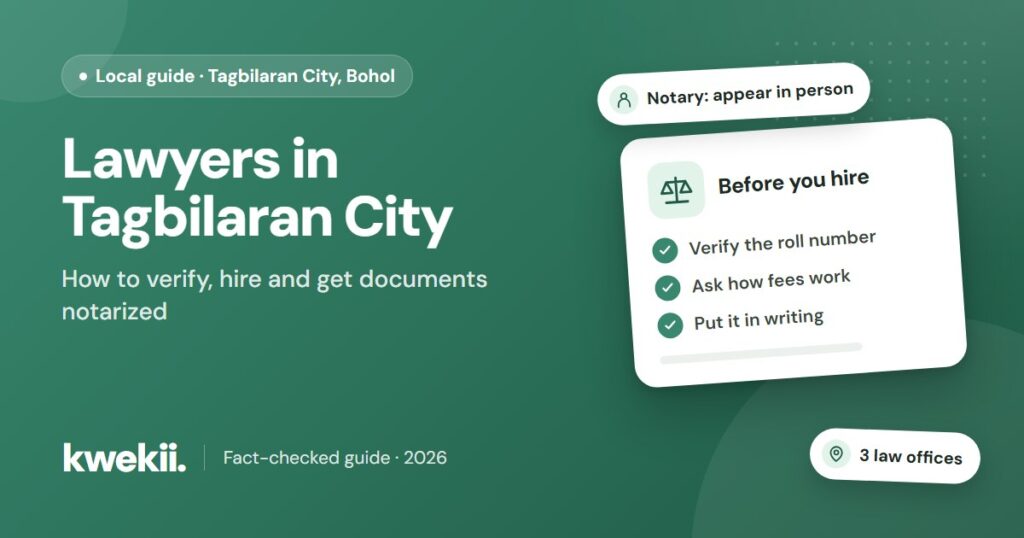
Quick answer: Kwekii lists three law offices in Tagbilaran City, Bohol: Bungabong Law Office (F. Rocha Street), Refugio Law Office (San Jose Street) and Vaño Law Office (A. Lesage Street). Before you hire, check the lawyer’s name and roll number on the Supreme Court’s Lawyers’ List, ask how fees are computed, and put the engagement in writing. If you can’t afford a lawyer, ask the Public Attorney’s Office (PAO) whether you qualify for free legal help.
Key takeaways
- See all listed offices with a map on Kwekii’s legal services page.
- Only a lawyer in good standing can be commissioned as a notary public, and you must appear in person, with a valid ID, to have a document notarized.
- Under the Code of Professional Responsibility and Accountability, fees must be fair and reasonable, and a lawyer can bind you in an engagement only through a written agreement.
Law offices in Tagbilaran City listed on Kwekii
| Law office | Location (as listed) |
|---|---|
| Bungabong Law Office | F. Rocha Street, Tagbilaran City |
| Refugio Law Office | San Jose Street, Tagbilaran City |
| Vaño Law Office | A. Lesage Street, Tagbilaran City |
Listed alphabetically. Kwekii doesn’t rank or endorse law offices, and this list isn’t legal advice. It reflects published profiles as of November 1, 2026. Call the office to confirm its hours and the kinds of cases it handles.
How to check that a lawyer is real
Every Philippine lawyer signs the Roll of Attorneys when admitted to the bar. The Supreme Court publishes a Lawyers’ List on its website showing each lawyer’s name, address, the date they signed the roll and their roll number.
- Ask for the lawyer’s full name and roll number. A real lawyer won’t mind sharing it.
- Look the name up on the Lawyers’ List. Check that the roll number matches.
- Remember the list shows admission, not current standing. A lawyer on the roll can still be suspended. If you have doubts, ask the lawyer for their current IBP membership details, or contact the Integrated Bar of the Philippines (IBP) Bohol chapter.
Lawyer or notary public: which do you need?
Many people visit a law office only to have a document notarized: an affidavit, a deed of sale, a special power of attorney. Under the 2004 Rules on Notarial Practice, only a member of the Philippine Bar in good standing can be commissioned as a notary public, and a notary can act only within the area covered by the court that commissioned them.
When you have a document notarized:
- Appear in person. The notary must not notarize a document if the person signing isn’t personally present at the time.
- Bring a current government-issued ID with your photo and signature. The rules list examples such as a passport, driver’s license, PRC ID, postal ID, voter’s ID, SSS card or PhilHealth card.
- Expect your details to be recorded. Notaries keep a notarial register with the date, the type of act and the name and address of each signatory.
A notary checks your identity and that you signed willingly. They don’t review whether the document protects you. For contracts, property and family matters, ask a lawyer to review the document before you sign.
What to ask before you hire a lawyer
1. Do you handle this kind of case?
Describe your matter briefly on the phone: land title, labor complaint, annulment, a business contract, a criminal case. Ask whether the office handles it, or who they’d recommend.
2. How do you compute your fees?
The Supreme Court’s Code of Professional Responsibility and Accountability (2023) says fees are fair and reasonable when based on factors such as the time and work required, how difficult the issues are, the lawyer’s expertise, customary charges and the IBP chapter’s recommended fee schedule, and the value of the matter to you. Ask whether you’ll pay a fixed fee, an hourly rate, a fee per court appearance, or a share of what you recover, and what costs (filing fees, travel, copies) are extra.
3. Can we put the engagement in writing?
The Code says a lawyer can bind a client in a legal engagement only when authorized through a written agreement. A short engagement letter that states the scope of work and the fees protects both of you.
4. How will you keep me updated?
Lawyers have a duty to regularly inform clients of the status and result of their matter. Agree early on how you’ll be updated (call, text or email) and how often.
Warning signs
- Someone approaches you uninvited, at a hospital, police station or barangay hall, offering to handle your case. The Code bars lawyers from soliciting legal business, directly or through others.
- Promises of a guaranteed win or “connections” with a judge.
- A notary who offers to notarize a document without you or the other signatories being present.
- Requests for large cash payments with no receipt or written agreement.
If you can’t afford a lawyer
The Public Attorney’s Office (PAO) gives free legal assistance to people who can’t afford a private lawyer. Applicants go through an indigency (income) test and, for court representation, a merit test of the case, with some exceptions. Income limits and the documents required are set by PAO and can change, so ask the PAO district office serving Tagbilaran City what proof of income to bring before your visit.
Frequently asked questions
How many law offices in Tagbilaran City are listed on Kwekii?
Three as of November 1, 2026: Bungabong Law Office, Refugio Law Office and Vaño Law Office.
How do I verify a lawyer in the Philippines?
Ask for the lawyer’s full name and roll number, then look them up on the Supreme Court’s Lawyers’ List at sc.judiciary.gov.ph. The list shows the name, address, roll signing date and roll number.
Can I have a document notarized without appearing in person?
No. Under the 2004 Rules on Notarial Practice, a notary must not notarize a document if the signatory isn’t personally present, and must identify you through a current government ID with your photo and signature, or through credible witnesses.
How much does a lawyer charge in Bohol?
There’s no single rate. Fees depend on the time and work involved, the difficulty of the case, the lawyer’s expertise and customary charges, among other factors. Ask the office how fees are computed and get the agreement in writing.
Where can I get free legal help?
Ask the Public Attorney’s Office (PAO). It provides free legal assistance to people who pass its indigency test and, for court cases, its merit test.
Sources
- Supreme Court of the Philippines: Lawyers’ List
- Code of Professional Responsibility and Accountability, A.M. No. 22-09-01-SC (2023) (Canon II Sec. 17; Canon III Secs. 4 and 41; Canon IV Sec. 6)
- 2004 Rules on Notarial Practice, A.M. No. 02-8-13-SC (Rule III Secs. 1 and 11; Rule IV Sec. 2; Rule VI) and its 2008 amendment on competent evidence of identity
- Law office names and locations: published business profiles on Kwekii, checked November 1, 2026.
This guide is general information, not legal advice. Facts were checked against the sources above on November 1, 2026. Researched and drafted with AI assistance, then reviewed and edited by Genmar Dadivo.