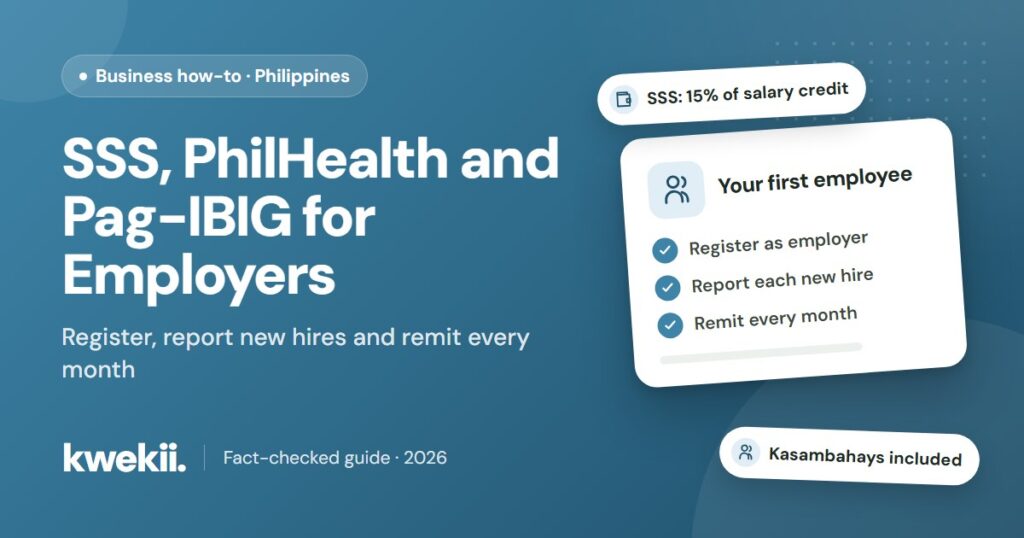
Quick answer: When you hire your first employee in the Philippines, you must register as an employer with SSS, PhilHealth and Pag-IBIG, report each employee right away, and remit both your share and the employee’s share every month. Under the current schedules, SSS is 15% of the employee’s monthly salary credit (10% from you, 5% from the employee), PhilHealth is 5% of monthly basic salary, and Pag-IBIG is 2% from each side on up to ₱10,000 of salary. You can’t deduct your own employer share from the employee’s pay.
Key takeaways
- SSS coverage is compulsory for employees, including kasambahays (household workers), under the Social Security Act of 2018.
- Every employee covered by SSS must also be covered by Pag-IBIG, and every employed worker is a PhilHealth direct contributor.
- Late remittances cost money: SSS charges a 2% penalty per month and Pag-IBIG 3% per month on unpaid contributions.
- Do this after your DTI business name and BIR registration.
Where this fits in starting a business
For a sole proprietor, the usual order is: register your business name with DTI, register with the BIR, get your mayor’s permit from your city or municipality, then register as an employer once you hire. Even a small sari-sari store or carinderia with one paid helper is an employer.
Employer contributions at a glance
| Agency | Contribution | Who pays | Late payment |
|---|---|---|---|
| SSS (RA 11199) |
15% of the monthly salary credit, which runs from ₱5,000 to ₱35,000 | Employer 10%, employee 5% | 2% penalty per month until paid |
| PhilHealth (RA 11223) |
5% of monthly basic salary, computed on at least ₱10,000 and at most ₱100,000 | Shared by employer and employee | Ask PhilHealth for current rules |
| Pag-IBIG (RA 9679, Circular No. 460) |
2% of monthly salary from each side, on a maximum fund salary of ₱10,000 (so up to ₱200 each) | Employer 2%, employee 2% (1% if earning ₱1,500 or less) | 3% penalty per month |
Rates are those set for 2025 in RA 11199 and RA 11223, the final years of each law’s schedule, and the Pag-IBIG maximum fund salary in effect since February 2024. The agencies can issue new rates, so check their current tables before you compute payroll.
Example: one employee earning ₱15,000 a month
| Contribution | Total per month | Your share | Deducted from the employee |
|---|---|---|---|
| SSS (15% of ₱15,000) | ₱2,250 | ₱1,500 | ₱750 |
| PhilHealth (5% of ₱15,000) | ₱750 | Split between you and the employee per PhilHealth’s premium table | |
| Pag-IBIG (2% each of ₱10,000) | ₱400 | ₱200 | ₱200 |
This is a simplified example. SSS uses salary brackets to set the monthly salary credit, so check the SSS contribution table for the exact amount for each salary.
Step by step: registering as an employer
- Finish your business registrations first. Have your DTI certificate (or SEC papers for a corporation), BIR registration and mayor’s permit ready. The agencies typically ask for proof that your business exists.
- Register as an employer with SSS. SSS accepts employer registration online through its My.SSS portal or at a branch. You’ll get an employer number, which you’ll use for all reports and payments.
- Register as an employer with PhilHealth and Pag-IBIG. Each agency has its own employer registration form and number. Check each agency’s website or visit its Tagbilaran branch for the current requirements before you go.
- Report each employee right away. The SSS and Pag-IBIG laws both say employers must “immediately report” each covered employee’s name, age, civil status, occupation and salary. Ask new hires for their existing SSS, PhilHealth and Pag-IBIG numbers; if they don’t have one, they can register as members first.
- Deduct, add your share and remit every month. Take the employee share from their salary, add your employer share, and pay by each agency’s deadline. RA 11199 says SSS contributions are due within the first ten days of the following month, or within the time the SSS sets.
- Keep records. Keep payslips and remittance receipts, and give employees a way to see that their contributions were paid. Employees can check their own records online.
Common mistakes to avoid
- Deducting your own share from the employee’s pay. RA 9679 says employers must not deduct their Pag-IBIG share from employees’ compensation, and RA 11223 says the same for PhilHealth.
- Waiting to report a new hire. Under the SSS law, if a contingency such as sickness or death happens before you report and pay for an employee, you can be liable for the benefits the employee would have received.
- Paying late. Penalties grow every month: 2% per month for SSS and 3% per month for Pag-IBIG.
- Forgetting household helpers. SSS coverage explicitly includes kasambahays and other domestic workers.
Frequently asked questions
Do I need to register with SSS if I have only one employee?
Yes. SSS coverage is compulsory for all employees and their employers, regardless of how many employees you have. It also covers kasambahays.
What is the SSS contribution rate for employers?
Under RA 11199, the 2025 rate is 15% of the employee’s monthly salary credit: 10% paid by the employer and 5% by the employee. The monthly salary credit ranges from ₱5,000 to ₱35,000.
How much is the Pag-IBIG contribution?
2% of monthly salary from the employer and 2% from the employee (1% if the employee earns ₱1,500 or less), computed on a maximum fund salary of ₱10,000. That’s up to ₱200 each per month.
What is the PhilHealth premium rate?
RA 11223 sets 5% of monthly basic salary for 2024 and 2025, with an income floor of ₱10,000 and a ceiling of ₱100,000. Check PhilHealth’s current premium table for each side’s share.
What happens if I pay contributions late?
SSS charges a penalty of 2% per month from the due date until paid, and Pag-IBIG charges 3% per month. Late payment can also leave employees without benefits when they need them.
Sources
- Republic Act No. 11199, Social Security Act of 2018 (Sec. 4(a)(9) contribution and salary credit schedule; Sec. 9 compulsory coverage; Sec. 22 remittance and penalty; Sec. 24 employer reporting)
- Republic Act No. 11223, Universal Health Care Act (Sec. 4 direct contributors; Sec. 10 premium schedule; Sec. 38 employer prohibitions)
- Republic Act No. 9679, Home Development Mutual Fund Law of 2009 (Secs. 6, 7, 23 and 24)
- DBM Circular Letter No. 2024-2, citing Pag-IBIG Fund Circular No. 460 (maximum fund salary raised to ₱10,000 from February 2024; contribution rates)
This guide is general information, not legal or accounting advice. Facts were checked against the sources above on November 2, 2026. Researched and drafted with AI assistance, then reviewed and edited by Genmar Dadivo.