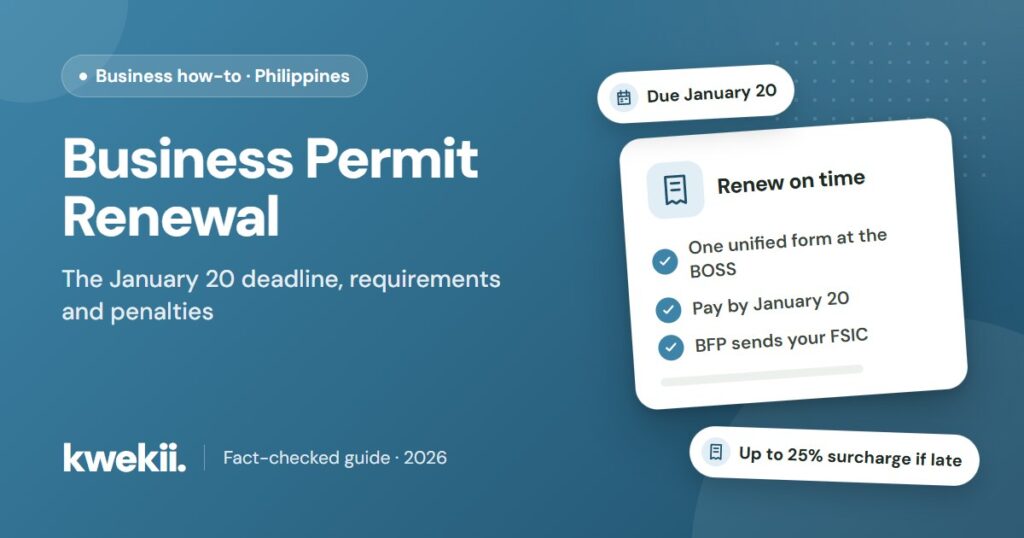
Quick answer: A business permit in the Philippines is valid for one year. Your city or municipality renews it either in January or on the anniversary of the permit, and local business taxes, fees and charges are due within the first 20 days of January, unless you pay in quarterly installments. Paying late can cost a surcharge of up to 25% plus interest of up to 2% a month. You renew at the city or municipal hall’s Business One Stop Shop (BOSS) with one unified form, and the barangay clearance and fire safety certificate are handled there too.
Key takeaways
- Pay local business taxes, fees and charges within the first 20 days of January, or quarterly within the first 20 days of each quarter. For 2027, the first deadline is January 20, 2027.
- Late payment can mean a surcharge of up to 25% and interest of up to 2% a month for up to 36 months. Your city or municipality’s revenue code sets the exact rates.
- Renewal uses one unified form at the BOSS, and the office can only ask for requirements listed in its Citizen’s Charter.
- If the city or municipality doesn’t act on your complete, paid renewal within its processing time, your permit is automatically extended.
When to renew
The Ease of Doing Business Act (RA 11032) says business permits are valid for one year. Each city or municipality chooses whether to renew them within the first month of the year or on the anniversary of the permit’s issuance (Sec. 11(e)).
Local business taxes follow the calendar year either way. Under the Local Government Code, local taxes, fees and charges accrue on January 1 (Sec. 166) and are paid within the first 20 days of January, or within the first 20 days of each later quarter if you pay in installments (Secs. 165 and 167). Quarterly payments therefore fall due by January 20, April 20, July 20 and October 20.
The city or municipal council (sanggunian) can extend the deadline without surcharges for a justifiable reason, but for no more than six months (Sec. 167). Watch your city or municipality’s announcements in December and January for any extension.
What you’ll pay
- Business tax. It’s based on your gross sales or receipts for the previous calendar year (Sec. 143). Each city or municipality sets its rates by ordinance, within the limits in the Code.
- A tax for each branch. Business tax is payable for every separate establishment or place where you do business (Sec. 146(a)). If you run two or more businesses taxed at the same rate, the tax is computed on their combined gross sales (Sec. 146(b)).
- Regulatory fees. The mayor’s permit and similar fees must be reasonable and in line with the cost of regulation, inspection and licensing (Sec. 147).
- Community tax (cedula). Your city or municipality may ask for your current community tax certificate. It’s due by the last day of February, with 24% a year interest if paid late (Sec. 161). Individuals pay ₱5 plus ₱1 for every ₱1,000 of income, with the income-based part capped at ₱5,000 (Sec. 157). Corporations pay ₱500 plus ₱2 for every ₱5,000 of gross receipts or real property, with the additional part capped at ₱10,000 (Sec. 158).
What you’ll usually need
RA 11032 requires a single, unified business application form for both new permits and renewals. It covers local taxes and clearances, the building clearance, sanitary permit, zoning clearance, other local requirements and the fire clearance from the Bureau of Fire Protection (BFP), and it must be available online and on paper (Sec. 11(a)). Sanitary permits and environmental and agricultural clearances are issued together with the business permit (Sec. 11(d)).
The office can only ask for requirements listed in its Citizen’s Charter, and it must tell you right away if something is missing (Sec. 9(a)). Check your city or municipality’s Citizen’s Charter for the exact list. Renewal lists often include:
- the filled-out unified business application form;
- your previous year’s business permit;
- proof of last year’s gross sales or receipts, such as your income tax return or financial statements;
- your barangay clearance, which is applied for and issued at the city or municipality (Sec. 11(f)). See our barangay business clearance guide;
- your current community tax certificate.
You don’t have to chase the fire safety inspection certificate (FSIC) yourself. For renewals, the BFP must give it to the city or municipality within three working days of your application (Sec. 12(c)).
Step by step
- Check the Citizen’s Charter and online options. RA 11032 required cities and municipalities to automate their business permit systems or set up an electronic BOSS within three years of the law (Sec. 11(c)). Ask whether yours accepts renewals online.
- Fill out the unified form. Declare last year’s gross sales or receipts.
- Get your assessment and pay. Pay the business tax and fees in full, or the first quarterly installment, by January 20.
- Tell the BFP about building changes. If you renovated, modified or altered your building, inform the BFP and submit its documents 30 working days before your permit expires (Sec. 12(c)).
- Claim your permit. Electronic permits from an electronic BOSS have the same authority as paper ones and can be printed (Sec. 11(c)).
How long it should take
Government offices must act within the processing time in their Citizen’s Charter. That’s no longer than three working days for simple transactions, seven working days for complex ones, and 20 working days for highly technical applications or those that pose a danger to public health, safety, morals or policy. An office can extend this only once, with written notice explaining why (RA 11032, Sec. 9(b)).
If the office fails to act on a renewal within the processing time, your permit is automatically extended, as long as you submitted all the requirements and paid all the fees (Sec. 10). Keep your acknowledgment receipt and official receipts. The same applies to the fire certificate: if the BFP doesn’t give the city or municipality your FSIC within three working days, you’re treated as having a temporary valid FSIC, which can be the basis for automatic renewal (Sec. 12(d)).
What happens if you pay late
The Local Government Code lets the sanggunian impose a surcharge of up to 25% on taxes, fees or charges not paid on time. It can also charge interest of up to 2% a month on the unpaid amount, including the surcharge, for no more than 36 months (Sec. 168).
For example, if your business tax is ₱10,000 and your city or municipality charges the maximum rates, paying three months late costs:
- a surcharge of ₱2,500 (25% of ₱10,000);
- interest of ₱750 (2% a month for three months on ₱12,500);
- a total of ₱13,250 instead of ₱10,000.
Your local revenue code may set lower rates. Ask your city or municipal treasurer’s office.
Closing or moving your business
Not renewing isn’t the same as closing. To retire a business, you submit a sworn statement of your gross sales or receipts for the current year, and pay any difference if the tax you’ve paid is less than the tax due on those sales (Local Government Code, Sec. 145). Do this before the new year’s taxes fall due, and ask the business permits office for its retirement requirements.
Renewing in Bohol
Tagbilaran City and every town in Bohol follow these national rules. Renew at your city or municipal hall, and ask its Business One Stop Shop or business permits office for the Citizen’s Charter, the local tax rates and whether online renewal is available. After you renew, check that your Kwekii business listing shows your current hours, phone number and address.
Frequently asked questions
What if the city doesn’t act on my renewal in time?
Under RA 11032, a renewal that isn’t acted on within the processing time is automatically extended, provided you submitted all the requirements and paid all the fees. Keep your receipts as proof.
Can I pay my business tax in installments?
Yes. Local taxes, fees and charges may be paid quarterly, within the first 20 days of each quarter (Local Government Code, Secs. 165 and 167).
Do I pay a separate business tax for each branch?
Yes. The tax is payable for every separate establishment or place where business is conducted (Sec. 146(a)). Ask your business permits office how it handles permits for branches.
Do I need to renew my DTI business name every year?
No. A DTI business name registration is valid for five years. See our DTI business name guide for renewal rules.
Do I still pay the BIR’s ₱500 annual registration fee?
No. The BIR stopped collecting it in 2024 under RA 11976. Our BIR registration guide explains what remains.
What should I do if I stopped operating?
Retire the business instead of letting the permit lapse. Submit a sworn statement of your gross sales or receipts for the year and settle any tax due (Sec. 145).
Sources
- Republic Act No. 7160, Local Government Code of 1991 (Sec. 143 tax on business; Sec. 145 retirement of business; Sec. 146 separate establishments; Sec. 147 fees; Secs. 157, 158 and 161 community tax; Sec. 165 tax period and installments; Sec. 166 accrual; Sec. 167 time of payment and extensions; Sec. 168 surcharges and interest)
- Republic Act No. 11032, Ease of Doing Business and Efficient Government Service Delivery Act of 2018 (Sec. 9 Citizen’s Charter requirements and processing times; Sec. 10 automatic extension; Sec. 11 unified form, BOSS, automation, one-year permits and barangay clearances; Sec. 12 fire safety certificates)
- DTI Business Name Registration System FAQ (five-year validity)